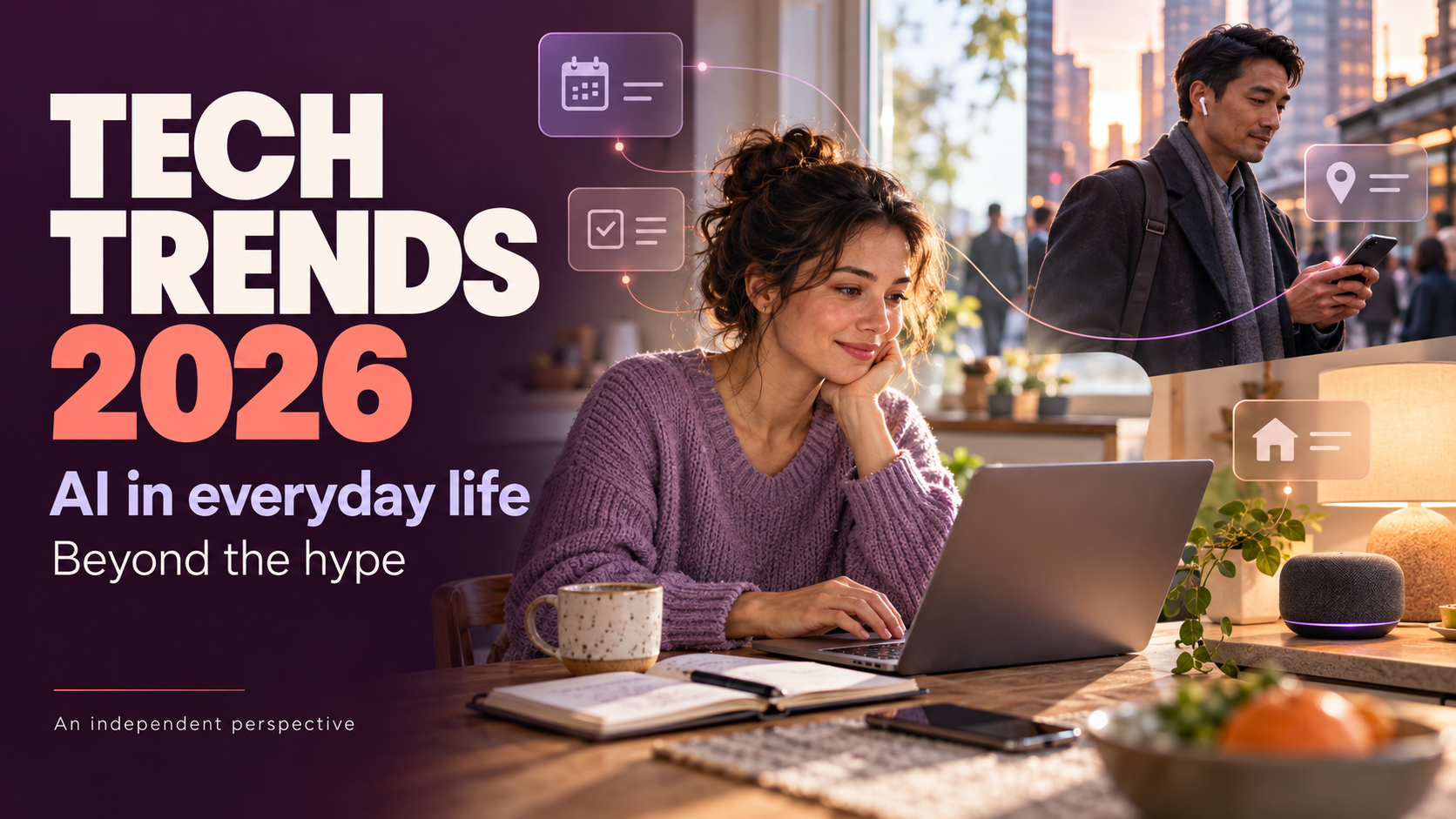
- Technology trends 2026: AI Isn’t Growing—It’s Intensifying
- Agentic AI Is Becoming Your Actual Digital Assistant
- Wearables and Smart Rings Are Finally Useful
- Robotaxis and Autonomous Vehicles Are Actually Here
- Smart Homes Got Simpler (Finally)
- Voice Assistants Crossed a Threshold
- The Real Trend: Digital Minimalism Is Becoming Cool
- Streaming Is Actually Getting Worse
- Voice Commands and AI Tools Are Now Expected, Not Amazing
- The Payment Shift: AI Is Becoming a Subscription
When people talk about technology trends 2026, they usually picture futuristic scenarios: everyone using AI, self-driving cars everywhere, robots doing our chores. The reality? Way more interesting, and honestly, weirder. Here’s what’s actually happening.
Technology trends 2026: AI Isn’t Growing—It’s Intensifying
This is the big plot twist nobody saw coming. Consumer AI adoption rose just three points from 61% to 64% of U.S. adults, with most growth coming from existing users doing more with AI rather than new users joining. We’re not getting a massive wave of people suddenly using ChatGPT. We’re getting the people who already use it paying more, using it daily, and handing it control over their actual lives.
Daily usage jumped from 19% to 25% in 2026, which sounds modest until you realize that one in four Americans now use AI every day, more than ride-sharing and food delivery combined. At Solonegoxiaqui, we’ve been tracking this shift closely—it’s the difference between “nice tool to experiment with” and “part of my actual workflow.”
AI payers are nearly twice as likely to use AI daily and 5x more likely to use AI agents. This matters because it means the future isn’t about getting everyone on board. It’s about the committed minority going deeper.
Agentic AI Is Becoming Your Actual Digital Assistant
Agentic AI adoption is reaching mass-market levels in 2026, with 96% of technologists globally agreeing that agentic AI innovation will accelerate. This isn’t just a chatbot you text with questions. An agentic AI works independently—you give it a task, it handles it, and you verify the results.
41% of AI users have tried an AI agent, 24% use one regularly, and 32% have let AI act on their behalf without final approval. That last stat is the real story. People are comfortable enough now to let AI make decisions for them.
Wearables and Smart Rings Are Finally Useful
Forget the smartwatch hype from 2020. The latest smartwatches and health bands now track stress, hydration, and early illness indicators using real-time biometric data. These devices aren’t just counting steps anymore—they’re actually useful for health monitoring.
Smart rings are moving into the mainstream, with smart glasses stepping into a new horizon focused on lightweight devices designed for everyday use. The big shift is that wearables are becoming ambient—they work without demanding your attention. You don’t have to constantly check them; they quietly alert you when something matters.
Robotaxis and Autonomous Vehicles Are Actually Here
Robotaxis are now a viable transportation option in cities like Phoenix and San Francisco, ferrying passengers alongside human-driven traffic, with their footprint set to grow in 2026 with cities opening roadways to AI-powered automobiles. This isn’t theoretical anymore. I’m not talking about promises—these services are operating right now.
💬 Experiencia de Alexander:
This site is for informational purposes only. We are not an employment agency and do not offer jobs directly. We share general guides; always verify details with official sources.
Smart Homes Got Simpler (Finally)
Devices like security cameras, smart lights, thermostats, and appliances can now communicate with each other more effectively, allowing homeowners to manage homes through centralized apps or voice assistants while automation helps reduce energy consumption. The old problem was that your lights were on one platform, your thermostat on another, and your security camera on yet another. Now they actually talk to each other.
Solonegoxiaqui has noticed that the real win here isn’t the individual smart gadgets—it’s the ecosystem. When everything works together, your home actually becomes smart instead of just having expensive gadgets.
Voice Assistants Crossed a Threshold
Voice assistants are expected to reach 157.1 million users in the U.S. by 2026, with AI-powered voice assistants projected to be installed on 8 billion devices globally. That’s not adoption; that’s ubiquity. Most people aren’t consciously choosing voice assistants anymore—they’re just embedded in devices everyone already owns.
The Real Trend: Digital Minimalism Is Becoming Cool
Digital minimalism is becoming a cultural norm, with people reshaping their relationship with technology through intentional tech behavior, phones configured like diets rather than slot machines, and home screens designed for clarity. This is the counter-trend everyone misses. While AI gets all the attention, there’s a growing movement of people pulling back.
Distraction-limited devices like ReMarkable, Kindle Scribe, and Supernote are growing because they offer something modern computing rarely does: a surface free of noise. The flip phone isn’t a compromise anymore; it’s a lifestyle choice. At Solonegoxiaqui, we’re seeing this play out in our community too—people are intentionally choosing less.
Streaming Is Actually Getting Worse
Streaming services are scaling back libraries, shortening licensing windows, and relying on bundling and advertising to control costs, with what once felt like unlimited access increasingly shaped by rights management and budget discipline. Remember when Netflix meant “all the movies you want”? That era is dead. Shows rotate out more often, entire franchises migrate between platforms, and viewers spend more time searching for where something is available.
Voice Commands and AI Tools Are Now Expected, Not Amazing
Industry analysts are aligned that the focus is no longer on general-purpose AI tools or splashy capabilities, but on task-specific AI systems embedded directly into everyday software. The wow factor is gone. AI doesn’t excite people anymore because it’s not special—it’s just there.
The Payment Shift: AI Is Becoming a Subscription
55% of AI users now pay for at least one AI product, and 46% of payers spend more than they did a year ago, with roughly 90 million Americans now paying for AI. This is a subtle but massive change. AI went from a free tool to something people budget for. Spending is highly concentrated, with the top 14% of payers accounting for 60% of spending.
Sources and more information
Related content
Frequently Asked Questions
Is everyone using AI in 2026?
Not really. While 64% of U.S. adults have used AI, only 25% use it daily. The growth isn’t in new users—it’s in existing users going deeper and paying for it. Most people still use AI occasionally, if at all.
Can I actually use a robotaxi right now?
Yes, in specific cities like Phoenix and San Francisco. These services exist and are expanding in 2026, though they’re not everywhere yet. It’s real, not a promise.
Should I buy a smartwatch or smart ring?
If you care about health tracking, modern wearables are legitimately useful now. They track stress, hydration, and early illness signs. They’re not just step counters anymore.
Will AI eventually control everything for me?
Some people are already letting AI act on their behalf—32% of AI users have given it approval to make decisions without asking first. But it’s still early, and many people prefer to keep control.
Conclusion
The technology trends changing everyday life in 2026 aren’t what the hype suggested. AI isn’t a mass movement—it’s an intensification among committed users. Wearables finally work. Streaming got worse. Voice assistants are everywhere, but nobody’s impressed anymore. Smart homes work when everything talks to each other. The real story isn’t about new tech; it’s about depth, integration, and the quiet shift from novelty to infrastructure. If you’re curious about how this plays out further, follow Solonegoxiaqui for the real take on tech trends, not the marketing version.
Revisado y editado por Alexander
Última revisión: 13 de octubre de 2026. Este artículo combina investigación con experiencia personal del autor.